Thursday, June 23, 2011

Reflection

I believe that Thailand has one of the most beautiful marine environments in the world. But for various reasons, we seems to be careless and do not appreciate our beautiful reefs enough. I believe that through awareness and promoting environmental consciences we will be able to preserve our amazing marine life for many years to come. I think that we should appreciate our coral reefs more and be grateful that we have been blessed with such marine diversities.

Being able to really witness the beauty and diversity of the coral reefs in Pattaya for the last few dives, I have grown to appreciate them more and also been surprised with how many different species of organisms I could find in such a small space and more surprisingly in Pattaya. I have always thought that the dive sites in Pattaya weren't that beautiful since the city is expanding which meant that tourism would have depleted the marine life in Pattaya. However, I was startled at the convenience of the boat and still the diversity of the marine organisms there. Since those dives where we have actually closely examine each area of the dives, I have been more eager to explore more dive sites in Thailand, since I feel more confident and calm underwater now. All the skills that we practiced in the pool all came naturally during the dive. I became much more calmer and patient in order for the small marine organisms to finally reveal themselves.

Scuba diving was a totally new activity for me and I was surprised at my capability to carry a 40 pound backpack on my back and still have an amazing time underwater. I never considered myself a strong person and I was surprised at how quick I was in assembling my equipment and also taking them apart. I frequently forget small details but I became efficient with all the equipments and also making myself comfortable underwater. Scuba diving is definitely not an individual activity and as much as I love to be independent, I realized that scuba diving is a group activity and it makes the experience much more memorable.

5 to 10 years from now, I hope to become an avid diver and I would learn to appreciate every dive I make. Most importantly, I will remember all of the skills I performed because they are the basics. I would definitely remember my first dive and every dive that I did this trip. I was such a great experience and even though there were difficulties and problems, I have learned from those mistakes. I would remember every single person on the boat and every person at Mermaids for making this dive trip such an amazing experience. I would remember all the trips we made between the hotel and the dive shop. Helping carry the tanks and equipment of the boat and back into the dive shop. Being stuck there, exhausted, and walking all the way back to the hotel.

I definitely enjoyed the last two days of diving. I thought that Koh Man Vichai was gorgeous and one of the best dives so far. I enjoyed time on the boat and all the walks we did between the dive shop and our hotel. Our ride to the pier and the time I helped carry all the equipment off the boat, even though it was the last day, and being stuck at the dive shop before having to walk all the way back to the hotel. Playing victim and being dragged on the boat on my stomach and every giant stride I made.

Dissection Activity

This dissection activity may be one of the most interesting activity yet. By dissection different types of fish and invertebrates, I was able to identify different parts of the organisms. I thought that the stomach, intestines and wastes were the easiest parts of the organisms to identify. The intestines were fairly large which made it easily accessible and I was able to identify them. The fishes were much more easier than the invertebrates. If only I had a knife, I would be able to dissect and cut open the fish more easier. The scalpel was small and was not that sharp, making the cutting much more challenging. I thought that the invertebrates' different organs were hard to identify since they were small in size. The most significant part was most definitely it's waste because it has a certain color. For the dissection of the fishes, I found it hard to look at it's gills because it was filled with dirt and all the things that the fish has filtered.

Obviously the invertebrates did not have a back bone and I did not find any bones in them either. However, it's muscles and tissues were much more difficult to cut open than the fishes. Both organisms had intestines and I also noticed that both of the organisms had filters in them. The invertebrates were bivalves and they are filter feeders. The fishes had filters in their gills. I thought that this activity was very educational and we were able to view marine organisms at a different perspective.

Monday, June 13, 2011

Wonders of the Gulf of Thailand

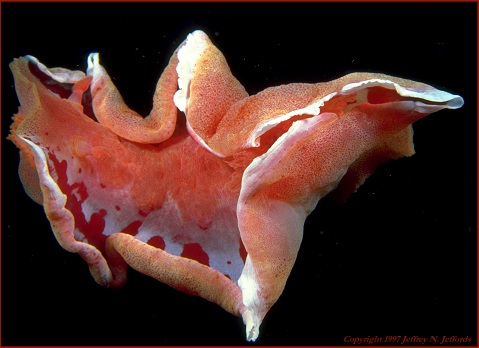
The movements of a Spanish dancer is mesmerizing. This puzzling nudibranch is extremely rare to find in Thailand. However, if I do continue my scuba diving certification, I am undoubtedly determined to search for one. Literally translated from its scientific name, Hexabranchus sanguineus, as six-gills blood colored, the Spanish dancer has two methods of travelling: crawling and swimming. When it  crawls, the wide endges of the parapodia, or its mantle, are rolled up close to the body. When it swims, the red parapodia unfurls, creating a dazzling undulating whirling motion through water, propelling the animal forward. Its common name "Spanish dancer" was given for it's whirling swimming movement and the red color of the mantle, comparable to the skirt movements of a flamenco dancer. All I want is to witness the movements of this baffling creature, to see if it's movements really do mimic the skirt of a flamenco dancer.
The music really does go with the movements of this Spanish dancer :)

Thursday, June 9, 2011

Most Interesting Marine Behavior

For me, I think that all marine behavior is just as fascinating as the other. Territorial behaviors showcase the different measures that marine organisms take to protect their grounds. The behavior of Moray eels were very interesting in a way that they get very easily threatened and that they will attack even if we were only making a friendly gesture. I never knew the importance of top predators. But now I understand that if the top predators were not present, the whole food chain would change. At first I thought that, the ocean would be better off without the top predators but I later realized that there will always be a top predator. I also found symbiosis relationships very interesting and it justified my curiosity of why some marine organisms would always stay together. I always thought that the remora was only there with the sharks to clean up their skin, the same way that particular birds clean up the skin of elephants or the teeth of crocodiles. I was never familiar with the different types of symbiosis such as commensalism. Most of all, I found marine schooling very intriguing and captivating. To see how schools of fish move in such a manner, made me dumbfound. I was puzzled at how the fish could move together in such unison and in such mesmerizing shapes and ways. One marine behavior that I was always attracted to was protective coloring. Underwater, some species of fish could camouflage so completely that we could not tell which was real and which was false.

In conclusions, I thought that marine schooling was the aspect of marine behavior was the most fascinating marine behavior. The conduct of fish school moving in such enthralling ways seemed completely impossible. This shows how cooperative and united fishes are. If only we humans could unify in the way that fishes do, all our solutions to various problems would have been resolved by now.

Tuesday, June 7, 2011

Promotion of Greater Awareness of the Connection between the Ocean and Our Atmosphere

The connection between the ocean and our atmosphere is vital to the growth on Earth. Each growth depends on each other, and if one changes, the other will too. If our atmosphere was contaminated with excessive amounts of CO2, the life under the ocean would change greatly. Sea water with larger amounts of CO2 would decrease in pH level thus creating a different environment for marine organisms to grow. With lower pH levels, sea urchins may not be able to grow their arms longer than usual their feeding system depends on the length of their arms, thus, it will grow slower, as a result of it's lower capability to feed themselves. As a result, animals that feed on sea urchins will also be affected with the depleting numbers of sea urchins. The food cycle would be vulnerable to change.

From this online experiment, I have now discovered the vitality of the connection between the ocean and our atmosphere. Life beneath the surface of the ocean will change if our atmosphere changes. Thus, with our continuation of emissions of CO2, we will eventually be effected by this, since our food also comes from the ocean. Ultimately, we should lower our CO2 emission considerably, in order to not only save marine life but also ourselves.

Monday, June 6, 2011

RIS Marine Biology Summer Course

When summer break approached, I was hesitant on what I was going to be doing this summer. A job? An internship? Just stay home and be a couch potato? The answer eventually became, no. I applied for the Marine Biology course conducted at our own, RIS, hoping to gain some environmental consciences and awareness. I was already a tree hugger (demanding every paper to be used on both sides, printing final essays on recycled paper, refusing to use paper cups at Starbucks), but there was something in my mind that I yearned to know. It was the life under the sea. Did they live just like humans? Or are fish's daily life consist of only eating and swimming around. I realized that one of the most intriguing reason that I joined this course was that it came with a diving certification. I first scuba dived when I was a kid but there was little that I took from that brief course. My uncle is an avid diver with more than 200 dives and his son has already completed his Open Water Diving certification, and soon, he will be completing his Advance certification in Koh Tao, where a ship has been recently sunk as a dive site. By the time I finish this course, I hope to be joining them, scuba diving around various dive sites in Thailand. From this Marine Biology course, I aspire to be a more eco-conscious person and be able to change different behaviors in my life that could eventually change the world, as a whole.

From our class yesterday, I had a brief introduction into the marine world. The Planet Blue video, especially, fascinated me and made me realize that marine organisms are just like human (part where the male fish was trying to flirt with the female but she seemed rather disinterested). The experiment also created a basic standard of knowledge about density, pressure and buoyancy. The second half of the day was also very engaging, as we were introduced to scuba diving. Even though I did not complete the Knowledge Review for Chapter 1, I completed the quiz with ease and I thoroughly understood the concepts of scuba diving